China Space Station
Tiangong
Tiangong, the Heavenly Palace, is China’s crewed station. It reached its T-shaped form in 2022. On the map it is labeled CSS, and its orbit stays closer to the equator than the ISS.
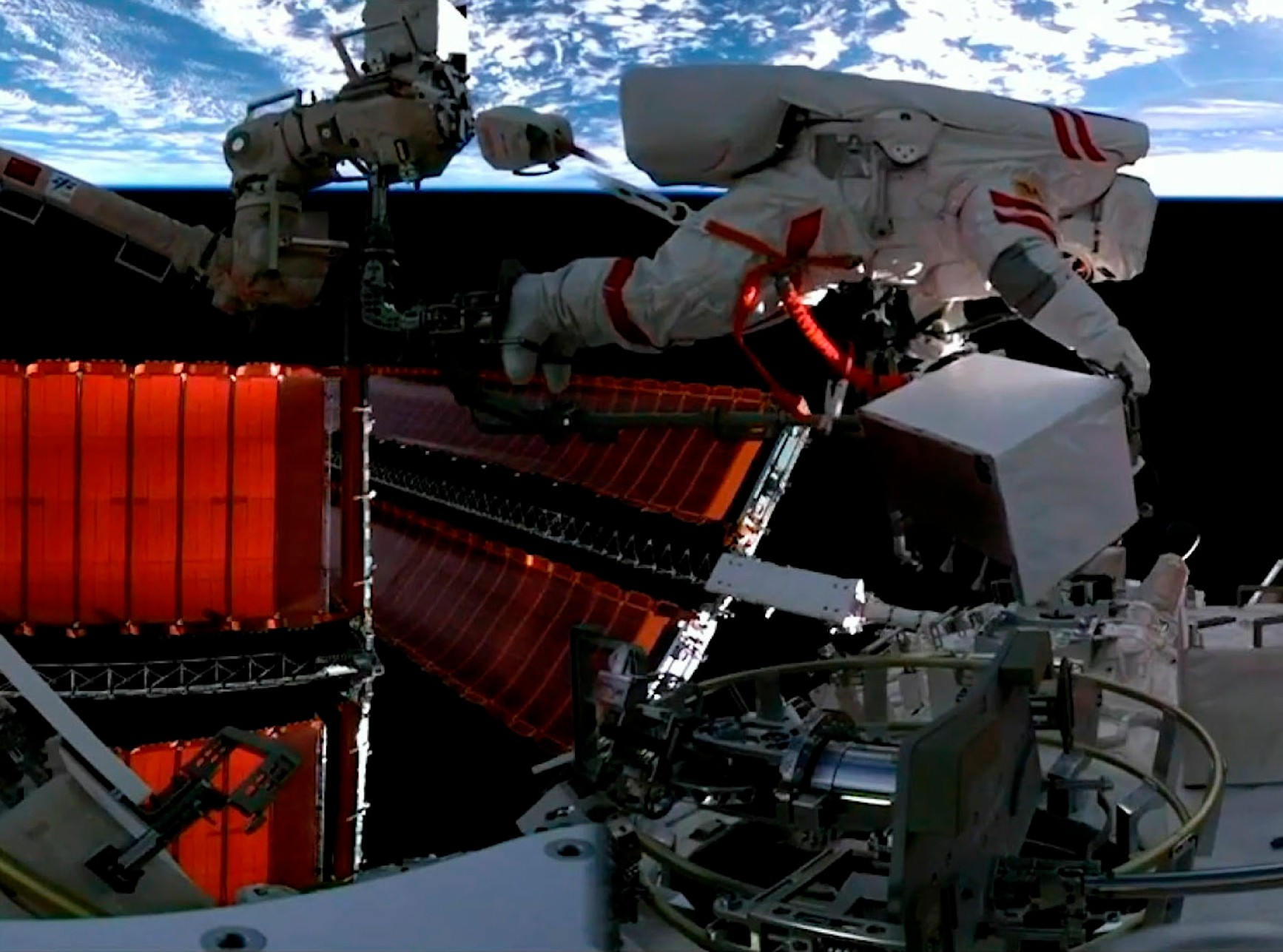
China Manned Space Engineering Office · CC BY 4.0
Core module
Tianhe, 2021
T configuration
2022
Inclination
41.5°
Altitude
~390 km
Crew
3
NORAD
54216
What it is
The China Manned Space Agency operates it. The Tianhe core launched on 29 April 2021. The Wentian and Mengtian laboratory modules docked in July and October 2022 and form the crossbar. Crews rotate aboard Shenzhou spacecraft.
How it moves
Low Earth orbit, near 390 km, at 41.5° inclination. It does not reach the higher latitudes the ISS does, so its ground track stays in a narrower band. One revolution still takes about an hour and a half.
Why the track matters
Farther south, Tiangong can miss a day the ISS still passes nearby. The map draws both, and a notice checks each station on its own.
On this map
Tiangong uses the same 500 km radius and the same hourly check as the ISS. The short label CSS keeps the two stations distinct on the controls.